Machine-shop assault and Otto’s death
American RustMachine-shop assault and Otto’s death is the fatal confrontation in which Isaac English, returning to help Billy Poe, strikes Otto the Swede with a heavy ball bearing. Isaac’s intervention interrupts the threat against Poe, but the killing transforms their attempted escape into a lasting moral and legal crisis. The scene makes a scrap of the Valley’s industrial past into a weapon, and leaves Isaac with a responsibility he cannot simply transfer to his friend.
Causes and Setting
The confrontation takes place in an abandoned machine shop, amid the remains of an industrial economy that once sustained the surrounding communities. For a century, the Valley had been a center of steel production; by the time Isaac and Poe were born, it had lost 150,000 jobs. The closures had damaged not only the mills but the network of smaller industries that depended on them. Many towns could no longer afford basic services, and some had lost their police forces. The scale of that collapse forms the event’s social background, though the evidence does not reduce the men’s violence to economic hardship alone.
The consequences of industrial decline appear in the characters’ family histories as well as in the ruined workplace. Grace Poe recalls that her father directed her into Penn Steel work at eighteen; she met Virgil Poe on the rolling line, became pregnant, and continued studying while caring for a baby. Layoffs ended her schooling before she completed her associate degree. Virgil survived several rounds of job cuts before losing his own position, and later training in robotics and work at a barge-making plant failed to provide lasting employment. The family kept its trailer after foreclosure sales were halted, relying on food-bank supplies and deer that Virgil poached. These histories establish the pressures surrounding Buell without making them a simple explanation for the attack.
The shop’s derelict machinery and scattered industrial remnants also shape the immediate action. When Isaac later searches for something with which to defend Poe, he considers a short length of iron pipe, then chooses a heavy ball bearing from among the scrap. What remains of industrial production is no longer functioning equipment: in the emergency, it becomes an improvised instrument of violence.
Assault and Intervention
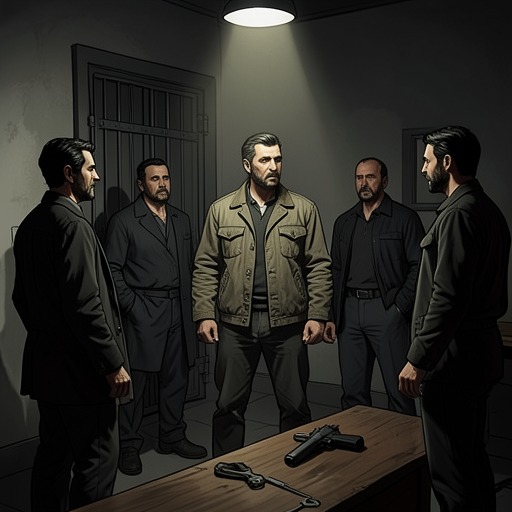
The danger begins when three men enter the building where Isaac and Poe have settled. The largest claims that they are occupying the group’s spot. Isaac stands, but Poe stays where he is and disputes the claim. After a disturbance inside, Isaac initially prepares an escape route across the field and waits for Poe to emerge. When Poe does not come, and the noise stops, Isaac recognizes that something may be wrong and decides to go back.
Before re-entering, Isaac hides his backpack and the money he has been carrying. He picks up the ball bearing, judging that the iron pipe would be taken from him, and slips in through a back door. Inside, Murray Clark is on the ground and Poe is being physically threatened and held against his will. Isaac remains in darkness while the men face away from him. Jesús calls for Otto, and another voice indicates that Isaac has already left. Otto then returns to the firelit area, apparently expecting to find Poe there alone.
Isaac throws the bearing as hard as he can. It strikes Otto, who collapses. Poe breaks free and runs out; Isaac stays frozen for a moment, watching Otto and recognizing from the force of the blow that he has killed him. Jesús kneels beside Otto. The action is brief, but its consequence is irreversible: Isaac has stopped the immediate threat to Poe by inflicting a fatal injury.
Flight, Return, and Encounter with Harris
After the assault, Isaac and Poe make their way away from the building and toward the railway tracks. The scene does not present their departure as a settled escape. When they later approach the machine shop again, the ground has been churned up by vehicles, and tracks lead up a muddy road. Bud Harris is waiting in his black-and-white Ford truck. Isaac and Poe emerge from the brush and see the truck’s lights come on; Poe walks toward Harris, and Isaac follows.
Poe suggests that Harris would not still be there if he had found Poe’s jacket, and treats their presence as something that can be explained away. Isaac is less reassured. As they pass the building, he imagines that investigators and the coroner have already arrived, and his thoughts turn sharply against Poe. He believes Poe will soon remember himself as innocent and forget that a person has died, while Isaac will be left carrying the choice he made. This is Isaac’s fearful, accusatory interpretation of Poe, not an independent confirmation of what Poe will remember or admit.
Harris’s encounter with the young men includes a joke that he will not arrest Billy Poe, followed by his clarification that the remark was a joke. The exchange does not resolve their exposure to the consequences of the killing. Instead, Harris’s presence places the boys’ private effort to manage the aftermath within the orbit of local law enforcement, where the evidence of their return and the death itself can no longer be treated as distant possibilities.
Responsibility and Narrative Significance
The scene’s central conflict is not only whether Isaac can save Poe, but who will bear the cost of doing so. Isaac’s hesitation outside the building gives way to decisive action when he understands that Poe is in danger. Afterward, however, he does not experience the act as a clean rescue. He sees Otto’s death as something he chose, and resents the possibility that Poe will treat the consequences as Isaac’s alone. The narration follows that division between outward action and inward reckoning: Isaac acts for his friend, then turns the event over repeatedly in his thoughts.
The bearing condenses that reversal. It is an industrial object found among abandoned scrap, heavy enough to change the course of the confrontation in a single throw. Its use links the violence to the material landscape of the closed mills without suggesting that the landscape itself dictates what Isaac does. The larger history of the Valley explains the ruined setting and constricted prospects; the scene nonetheless insists on the particular choice made inside it.
The event therefore binds loyalty to responsibility rather than allowing one to cancel the other. Isaac prevents further harm to Poe, but the rescue does not absolve him of killing Otto. Their flight, their return to the shop’s vicinity, and Harris’s waiting truck extend the consequences beyond the moment of impact. The death becomes the point from which Isaac’s effort to protect Poe and his struggle to face his own part in what happened proceed together.